Overview:
Keeping up a centuries-old tradition, a new generation of chefs in America is rewriting the beloved Indian chaat and its riot of flavors while keeping memories alive
Chaat: A potpourri of memories
There is a particular cruelty to food memory: it arrives without permission. You are in a supermarket in Sunnyvale, your hand closing around a bunch of cilantro, and suddenly you are somewhere else — on a street in Delhi, or in your mother’s kitchen, or standing at a platform stall with a paper cone of bhel and a train to catch. Close your eyes, and you can still picture the hiss of oil when a tikki hits the griddle. Cumin toasted to the edge of burning, its fragrance unlocking like a room you haven’t entered in years. Chaat does this more reliably than almost anything else.
Chaat is one of the few foods on earth that encodes an entire civilization’s approach to pleasure — the belief that the most satisfying thing you can eat is something that contradicts itself, that holds tension in balance, that gives you sweetness and then pulls it away with acid, that offers crunch and then softens it with yogurt, that lights you on fire and cools you down in the same mouthful.
Few foods are simultaneously this ancient and this alive. And what Indian-American chefs are doing with chaat today — in San Francisco, New York, Scottsdale, Long Island — is not a departure from its history but its latest chapter. To understand where chaat is going, we have to understand where it has been.
Courts of Agra & a philosophy of contrast
The story begins in the dust and grandeur of the Mughal era.
According to culinary anthropologist Kurush Dalal, chaat originated in northern India in the late 17th century, during the reign of Shah Jahan. Food historian Colleen Taylor Sen documents in Feasts and Fasts: A History of Food in India, the spiced, acidulated street foods of Mughal-era northern India were believed to aid digestion and protect against impure water — a utilitarian origin story for one of the world’s great pleasure foods. One account, more legend than record but persistent for good reason, places the first chaat in the court of Shah Jahan, whose physicians reportedly encouraged the consumption of highly spiced, acidulated foods to protect the emperor and his nobles from the waters of the Yamuna, believed to carry illness. Whether the details are literal or embroidered, the story illuminates something true: from the very beginning, chaat was conceived as a logic. Not a recipe but a set of governing principles.
Those principles are ancient and remarkably stable. Every successful chaat is built on the same architecture: khatta, sour — usually tamarind, raw mango, or lime; meetha, sweet — from jaggery or a dark chutney; teekha, spicy — from fresh green chilis or the dried ginger and black salt buried in chaat masala; and namkeen, savory — from the fried elements, the starch, the base. These four qualities are not meant to exist in sequence, the way courses arrive at a dinner table. They arrive simultaneously, layered, each one sharpening the others.
The Hindi word chaat comes from chaatna — to lick. The name is its own description: food so compulsive that decorum becomes impossible. You lick your fingers. You reach for more before you’ve finished swallowing.

Street vendors understood this as intuitively as any modern chef understands umami. They were the original flavor architects, working without written recipes, calibrating chutneys and masalas daily by taste and season and the wordless feedback of a returning customer. They built complexity without the apparatus of a professional kitchen. And they built it brilliantly differently in every city they inhabited.
A subcontinent of interpretations
Chaat’s genius and the reason it has survived and proliferated for centuries is that it was always local. Delhi codified the aloo tikki: crisp-edged discs of spiced potato, fried in shallow oil and served under a generous flood of beaten yogurt, sweet tamarind chutney, and sharp coriander-mint chutney, finished with sev, the fried chickpea noodles that are chaat’s most loyal accompaniment. At its best — at a cart in Lajpat Nagar or Chandni Chowk on a winter evening — the aloo tikki is one of the great dishes of the world. Simple in its components, extraordinary in its result.

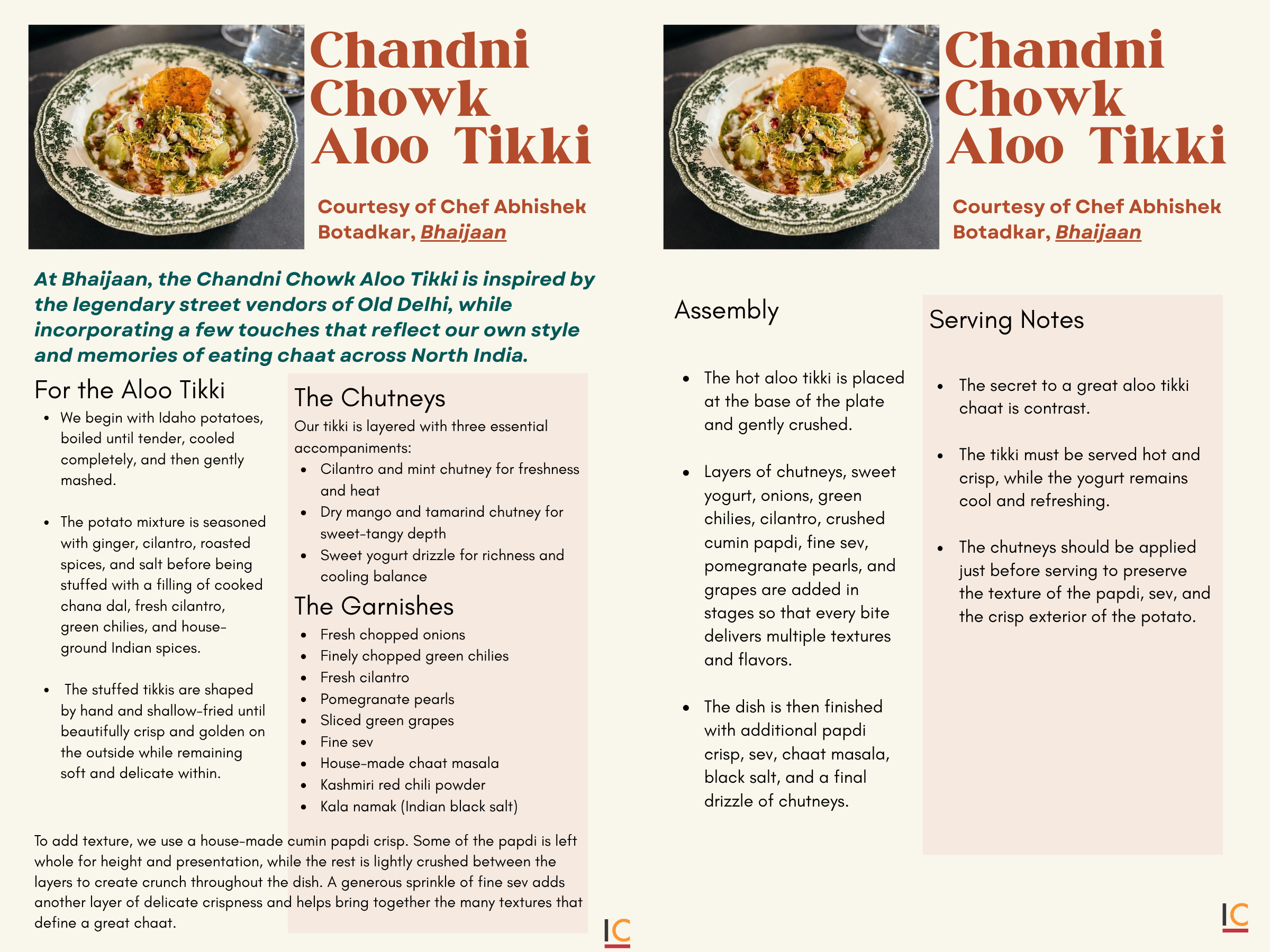
Chef Abhishek Botadkar of Long Island’s Bhaijaan (who has shared his secret recipe with us) says, “What makes this dish so beloved is the explosion of flavors and textures in every bite. You first experience the crisp exterior of the potato tikki, followed by the earthy warmth of the spiced chana dal filling. The sweet yogurt brings a cooling creaminess that softens the heat of the fresh green chilies and cilantro-mint chutney. The dry mango and tamarind chutney contribute a sweet-sour tang that ties everything together. The result is a dish that is crunchy, creamy, spicy, sweet, tangy, refreshing, and deeply nostalgic—all at the same time. That’s the magic of a great Chandni Chowk Aloo Tikki.”
Mumbai went in an entirely different direction. Bhel puri, the city’s signature, is a study in contrast without heat: puffed rice, fine sev, diced raw onion, tomato, boiled potato, and two essential chutneys — sweet tamarind and sharp green — tossed together at the moment of serving so the rice stays crisp for exactly as long as it takes to finish the bowl. Vendors at Chowpatty Beach have been making it this way for more than a century, each with their own proportions and their own loyal customers who will tell you, with complete sincerity, that no one else’s is as good.
Kolkata gave the world phuchka, known elsewhere as pani puri or gol gappa, but in Kolkata, fiercer, more intensely tangy, made with a spiced water so bracingly sour that first-timers occasionally recoil before they understand that this is, in fact, the point. The vendor fills each hollow, crisp puri with a spoonful of mashed potato and chickpea, pours in the tamarind water, and hands it across in a single motion. You eat it in one bite — the puri shattering, the liquid flooding your mouth all at once. There is no other food quite like it.
Varanasi developed tamatar chaat, built around a slow-cooked tomato base. Lucknow elevated the basket chaat into elaborate edible architecture. Surat has locho, dense and yielding. Ahmedabad has sev usal. Each city’s vendors worked in conversation with local produce, local spice preferences, local ideas about what a snack should do and none of them felt bound by what was happening two hundred miles away. In chaat, authenticity has never been the governing principle. Adaptability has.
It is a quality that would serve the food well on the other side of the world — though not without a fight. “The immigrant cook has long been trapped by a demand for cheap authenticity,” says Krishnendu Ray, chair of food studies at NYU and author of The Ethnic Restaurateur. “If it is expensive, it cannot be authentic — that is the assumption.” What the current generation of Indian-American chefs is doing with chaat is, among other things, a direct refusal of that constraint.
Train departing shortly
There is a particular kind of chaat that every Indian who has traveled by train knows in their body, and it deserves its own chapter in this history. The Indian Railways — that vast, chaotic, beloved institution carrying some 23 million passengers daily — produced its own culinary ecosystem. Platform vendors selling chai in clay cups, samosas wrapped in newspaper, sliced cucumber with salt and lime, bhel in paper cones, were as essential to the experience of train travel as the journey itself. You ate standing on the platform watching the departures board, or you were served through the window, handing coins down to a vendor as the train idled.
This is the chaat many Indian immigrants to America carry most viscerally, not the chaat of a restaurant or a festival, but the chaat of transition, of movement, of arriving somewhere and departing from somewhere else. It is, in retrospect, a fitting metaphor. The food that accompanied migration was itself a food defined by movement, by adaptation, by the willingness to become something slightly different in each new place it landed.
When the first wave of Indian immigrants arrived in the United States in the 1960s and 1970s – professionals, engineers, academics, people who came to build new lives without any guarantee of return – they brought these flavors in the only way they could: in memory. Chaat masala packed tightly in tins. Dried mango powder in small bags. Recipes were reconstructed from recollection in American kitchens, substituting what was available for what was not, adjusting, improvising, making do.
The chaat that appeared in the early Indian restaurants of Edison, New Jersey, and Devon Avenue in Chicago, and the strip malls of Fremont and Sunnyvale, was not identical to what you could eat in Delhi or Mumbai. It didn’t need to be. It needed to taste like home, which is a different and more complex requirement than tasting exactly like something.
The strip mall years

For decades, chaat in America lived in a specific kind of place. Low-lit, Formica tables, laminated menu with photographs. The glass case near the register displayed samosas, kachoris, and dhoklas. The cook is visible through a window at the back, working fast, without ceremony. The clientele is almost entirely South Asian, speaking in a mixture of languages, bringing children who would grow up with these flavors so deep in their palates that they would spend years in other cities and other kitchens, trying to reconstruct them.
Restaurants like Vik’s Chaat in Berkeley, Chaat Bhavan in Fremont, and dozens of others across the country were not, in the standard culinary narrative, serious establishments. They were not reviewed in national publications. They were not the kind of place food writers went to discover the next big thing. They were community institutions, which is a higher and more durable category than trendy places, one that American food media has historically been slow to recognize, till now.
What these restaurants were doing, quietly and without fanfare, was maintaining a living tradition. Keeping the flavors alive. Feeding engineers and doctors and graduate students and their American-born children, who grew up understanding, at a cellular level, what chaat was supposed to taste like and feel like and do to you.
That second generation is now cooking professionally. And what they are doing with chaat is among the most compelling things happening in restaurants today.
The chefs who carry it forward

At Besharam in San Francisco, Chef Heena Patel does not describe herself primarily as a chaat chef. She is a Gujarati chef, and the distinction is precise and meaningful. Gujarati cuisine is organized, at its core, around the same governing principle that chaat makes explicit: every dish should hold khatta, meetha, teekha, and namkeen in dynamic balance. Chaat, for Patel, is not a borrowed form. It is the form that most openly articulates what her culinary tradition has always believed.
Her summer fruit chaat — pineapple, mango, papaya, and peaches tossed with chaat masala, fresh lime, olive oil, and a touch of togarashi — is, on the surface, an eclectic composition. The olive oil is Californian. The togarashi is Japanese. But the logic is recognizably Indian, and the result feels like a resolution: California produce finally subjected to a flavor philosophy centuries older than the farms it came from.
“As a Gujarati chef, I’m always looking for ways to balance sweet, sour, spicy, and savory flavors in a single bite,” Patel says. “Fruit chaat does exactly that.” What her version illuminates is something the strip-mall restaurants always knew but the broader food world is only beginning to appreciate: chaat was always seasonal, always local, always working with whatever was freshest and most available. The farm-to-table philosophy that transformed American fine dining in the early 2000s was something chaat vendors on the streets of Delhi had been practicing for centuries.

For Chef Ajay Walia, chaat is more than a dish. “It is a philosophy of flavor-building that inspires how we cook,” he said. Across RASA, Saffron, and Amara, we see that spirit through three distinct interpretations. RASA’s Corn Chaat offers a bright, coastal expression, Saffron’s Rajasthani Chaat evokes bold flavors and nostalgia, while Amara’s Celeriac Kebab Skewers with Strawberry Harissa Reduction translate chaat’s hallmark balance of sweetness, smoke, heat, and acidity into a Mediterranean context.

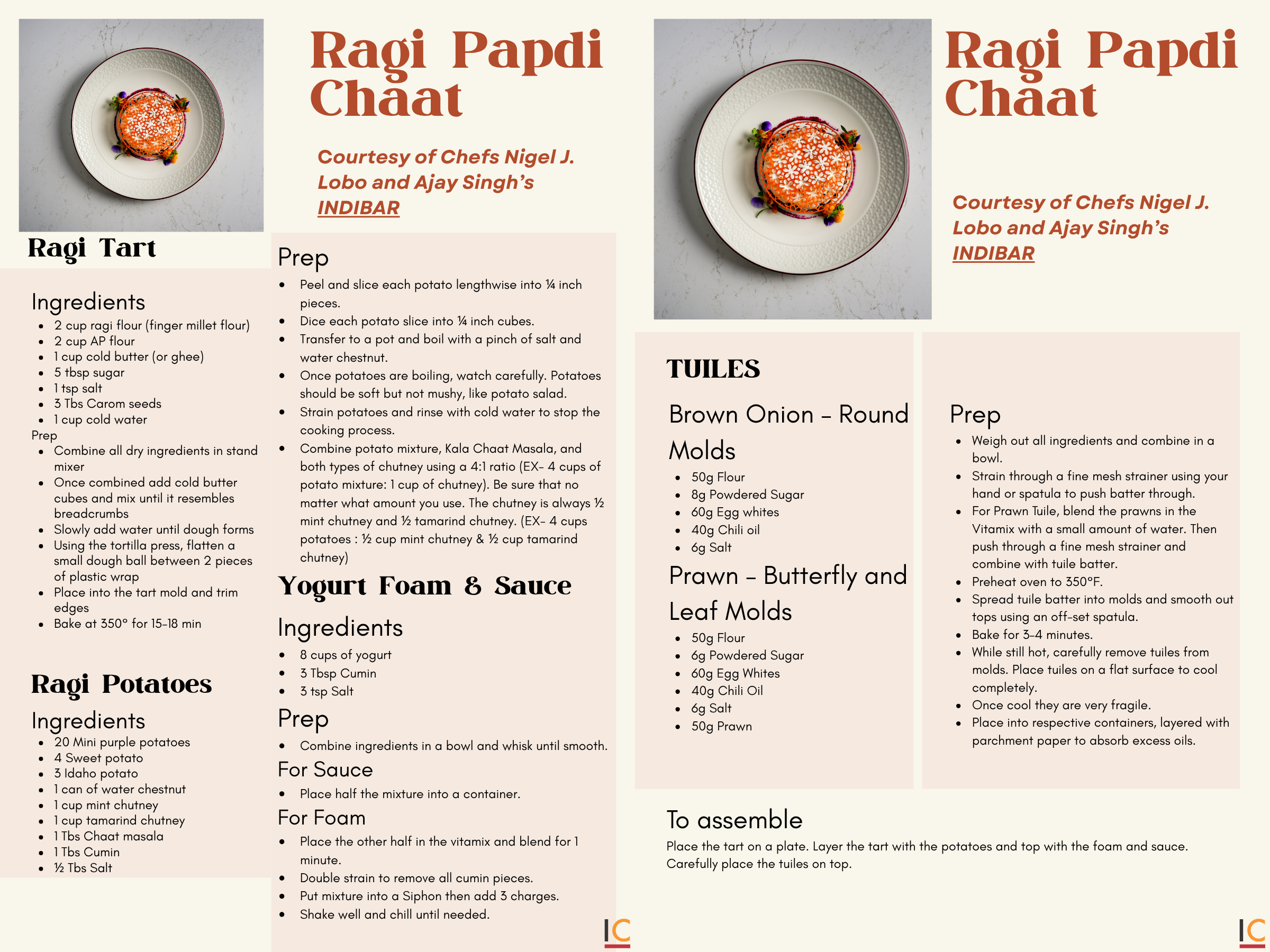
At INDIBAR in Scottsdale, Arizona, chefs Nigel J. Lobo and Ajay Singh approach chaat as both inheritance and experiment. Their Ragi Papdi Chaat (recipe below) replaces traditional wheat crisps with wafers of finger millet: earthier, more nutritionally complex, carrying the faint mineral depth of ancient grains, then builds on them with sweet potato, water chestnut, and yogurt espuma, a modernist technique that transforms the hand-beaten dahi of the street cart into something architectural and airy.
The vocabulary has changed.
On Long Island, Chef Abhishek Botadkar of Bhaijaan takes the opposite path, pulling his references tight rather than extending them outward. His Chandni Chowk Aloo Tikki is an act of fidelity to Old Delhi so precise that it functions almost as an argument: the original, executed with absolute conviction and craft, needs no improvement and requires no apology. His Palak Patta Chaat — spinach transformed through frying into a delicate structure, then layered with the traditional sweet-sour-spicy dressing — is traditional, made luminous by execution.
At Tamarind Tribeca in New York City, Palak Chaat has become an emblem of what happens when street food crosses into fine dining without losing its soul. The dish arrives with the precision of a composed restaurant plate — crispy spinach, yogurt, tomatoes, and sev arranged with care — and yet retains the bluntness, the immediacy, that chaat fundamentally demands. It does not ask to be studied. It asks to be eaten.
In the orbit of Unapologetic Foods, the New York restaurant group that has become one of the most consequential voices in contemporary Indian dining, chaat’s philosophy informs the work even when the menu doesn’t announce it by name. At Semma, Chef Vijay Kumar draws on South Indian snack traditions that share chaat’s obsession with textural contrast and layered heat. At Adda, Roni Mazumdar and Chef Chintan Pandya embrace the communal, unguarded generosity that Indian street food has always been organized around, the conviction that food can be both sophisticated and completely approachable, that in India, these qualities have never been in conflict.
Chaat-ing its own course…

A spread at Besharam, San Francisco (Photo courtesy: Besharam) 
Chandni Chowk Aloo Tikki from Bhaijaan, Long Island. (Photo courtesy: Bhaijaan) 
Rajasthani Chaat at Saffron, San Carlos, CA. (Photo courtesy of Saffron) 
Ragi Papdi Chaat at INDIBAR in Scottsdale, Arizona. (Photo courtesy INDIBAR) 
Corn Chaat at Rasa, Burlingame, CA. (Photo courtesy of Rasa)
(Above: Slideshow of America’s evolving chaat offerings)
Chaat emerged in Mughal courts but was democratized by street vendors who made refinement available to anyone who could spare a few coins. It traveled on train platforms across a subcontinent of one billion people. It crossed an ocean in the memories of immigrants and reconstituted itself in American kitchens and strip-mall restaurants. It fed the engineers who built Silicon Valley and the children those engineers raised. And now those children are cooking it, not as an act of nostalgia, but as an act of identity, of claiming space, of insisting that the culinary tradition they were born into is as sophisticated and as worthy of serious attention as any other on earth.
Indian cuisine in America has spent decades being flattened, reduced to curry, to a handful of familiar dishes, to a register of exoticism that serves the gaze of people who don’t actually know the food. Chaat resists this flattening absolutely. It is too complex, too regional, too insistently alive to be reduced to a single story. Every city has its version. Every family has its proportions. Every chef has their entry point. The ingredients change. The setting moves from a cart under a monsoon sky to a restaurant kitchen in the Bay Area fog. But the experience, that specific, irreducible collision of sweet and sour, crisp and yielding, fire and cool, is exactly what it has always been.
Chaat was never just a snack. It was always a way of saying: I come from somewhere. And where I come from knows how to savor.
Your chaat fix in the Bay Area
The Bay Area has one of the most layered chaat landscapes in North America, a palimpsest of decades, from the community institutions that fed the first generation of Indian immigrants to the contemporary kitchens remaking the tradition for a new one.

- Vik’s Chaat (Berkeley) — The standard-bearer. Vik’s has anchored its place in Berkeley’s culinary consciousness for decades, drawing weekend lines out the door and a clientele that spans every generation of the Bay Area’s South Asian community and beyond. The dahi puri, papdi chaat, and pav bhaji are the reference points against which everything else gets measured.
- Chaat Bhavan (Sunnyvale, Fremont) — Deep in the South Bay’s South Asian corridor, Chaat Bhavan is the strip-mall institution at its most essential: serious cooking, honest prices, and on a Saturday afternoon, a room that looks like a cross-section of the entire Indian diaspora.
- Chandni Chowk (Fremont) — Named for Old Delhi’s most storied market street, this Fremont spot brings the flavors of North Indian street food into the heart of the Bay Area’s largest South Asian community.
- Chatpatta Corner (Fremont) — A neighborhood fixture whose name, chatpatta, means tangy and spicy. It’s the kind of place regulars don’t share too loudly.
- Kailash Parbat (Santa Clara & Dublin) — A Bay Area outpost of the beloved Mumbai institution, bringing the city’s sev puri and dahi bhalla pedigree to the South Bay.
- Besharam (San Francisco) — Chef Heena Patel’s Dogpatch restaurant is where tradition meets contemporary evolution. The chaat here is Gujarati in its sensibility — built on a dynamic balance between sweet, sour, spice, and savory — but filtered through Patel’s California larder and her willingness to follow the logic wherever it leads. The seasonal fruit chaat is the most Californian version of a very Indian idea you are likely to find.
- Rooh (San Francisco, Palo Alto) — Progressive Indian cooking that takes chaat’s governing principles — contrast, layering, opposing flavors — and extends them into a full fine-dining vocabulary.
- Tiya (San Francisco) — Among the newer wave of Bay Area restaurants taking Indian cuisine seriously on its own terms. Chef Pujan brings ingredient-driven sensibility to his onion kachori and dahi papdi chaat with texture and balance that have always defined the form.
- Additional stops worth seeking out: Pav Bhaji Hut (Sunnyvale, Fremont), Chatori Chaat Food Truck (Santa Clara), Star Chaat (Pleasanton), Delhiwala Chaat (Sunnyvale), Annapoorna (Milpitas), Johal Chaat & Curry (Sunnyvale).
Vendors preparing fruit chaat in India in photo collage. Photo by gaf clickz on Unsplash
Man in front of chaat stall. Photo by Joyanto Joy on Unsplash