Overview
Vara encouraged the artists to respond to the theme in their own words, asking them to first give her a word or phrase responding to ‘Journey & Exile,’ and “then create from that.”
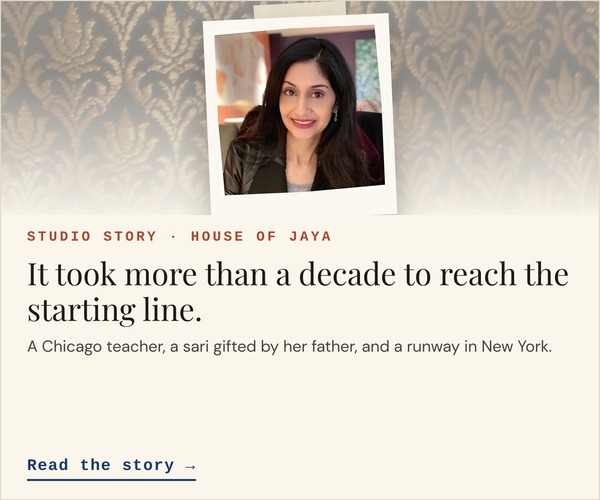
Vara Ramakrishnan’s home in Los Altos Hills was just two miles from the Northern California forest fires that moved swiftly into the Bay Area in August 2020. The smoke-filled skies lit orange with fire triggered evacuation warnings for the surrounding foothills.
“They told us to be ready to leave at a minute’s notice. My daughter was going away to college that summer, so we packed her two suitcases because you can’t start college if you’ve lost all your clothing,” says Vara. She hurriedly packed her children’s photos, her jewelry, “and all my sarees,” she remembers.
Later, looking back on that terrifying moment, with only minutes to decide what to save from the fires threatening her home, Vara instinctively reached for her sarees.
Vara is an artist, yet she did not take any of her paintings or sketchbooks with her. She realized she had instinctively saved the things that meant the most to her. Her sarees were more than beautiful garments; they held memories of family, celebrations, and home.
It was a pivotal moment for Vara, who then told herself, “I’m going to try to make the sarees that I want. I want to create them. I want to paint on them.”

Sarees at the Asian Art Museum
Vara immersed herself in the craft of saree weaving, seeking artists willing to reinterpret their craft in a new medium. That unexpected journey culminated on March 29 at the Asian Art Museum “Unstitched: A Celebration of the Saree,” an exhibition that reimagined the enduring garment as a canvas for fine art.
EnActe Arts, America’s largest South Asian theater company, helped build a relationship with the Asian Art Museum, said Vara. The museum has been working to engage more deeply with the Indian community. “I don’t think the Indian community necessarily sees it as their museum,” she explained, noting that many people associate the name “Asian Art Museum” primarily with East Asian cultures, not realizing it also represents South Asian communities.

“Unstitched: A Celebration of the Saree” wove together three distinct elements: Vara’s reimagined saree collection, “Journey & Exile”; a fashion show curated by EnActe Arts and Vinita Sud Belani; and an exhibition curated by Pia and Neel Ganguly of Pia Ka Ghar, exploring the history, craftsmanship, and diversity of the saree tradition.
The Beginning
At a Kalamkari residency in Srikalahasti, near Tirupati, Vara learned just how demanding the art form can be. “Kalamkari is very unforgiving,” she said. “Once you put a mark down, it stays in the fabric forever.”

She soon realized that commissioning custom sarees on her own was impractical; it needed to become a collaborative process.
“When you weave one, you get eight,” she said. “I thought, I’m going to be swimming in these sarees — this really has to become a group project.”
She began approaching artists, telling them she envisioned the sarees eventually being displayed in museums.
“For me, the museum idea almost came from speaking it into existence.”
Vara had originally planned to launch the exhibition in 2027, but the Asian Art Museum wanted to open in March (2026). So she bought a ticket to India at the end of October and traveled across the country, meeting artists and agents. “I signed up 41 artists, of whom about 33 to 35 ultimately came on board,” she said.
The Artist’s Vision
She then sent each artist a practice swatch made from the same silk used in the sarees. The fabric was woven into sheets and then cut into one-meter lengths, allowing artists to experiment before creating the final piece. They could choose between Kanchipuram and Banarasi silk; each material absorbs and responds to paint differently because of its unique weave and yarn structure.
Vara asked the weavers for ‘neutral’ Kanchipuram and Banaras sarees to distribute among the artists. The brief was clear: no figurative elements, just a neutral canvas. Then the weaving began.
“We gave the artist leeway, saying, ‘What do you want, what colors are you thinking of?’”

Some artists wanted a particular type of sari to make their vision come alive. She also set up a fabric dyeing operation in Jodhpur for other artists.
“Fabric painting is one of the hardest forms,” explained Vara. “You can’t pause midway; once it dries, you can’t get a uniform effect.”
Instead of hand-painting all the sarees, she helped translate some designs into embroidery-based pieces, including her own. Artists worked back and forth with studios to adapt their work for stitching.
Artist Collaborations
Rather than assigning a fixed narrative to represent the art in the project, Vara encouraged the artists to respond to the theme in their own words, asking them to first give her a word or phrase responding to ‘Journey & Exile,’ and “then create from that.”
“It really resonated with the artists,” said Vara. “Each has taken their own spin on it.”
Some artists drew on mythology, migration, language, and spiritual narrative. Others traced journeys across time and geography, blending the landscapes of India and California into their vision. Her early conversations focused on understanding each artist’s process.

Thota Tharani, she said, “was an insane delight to work with.” A creative genius with a playful spirit, Tharani recreated the graph paper he used to sketch elaborate film set designs. From him, Vara commissioned a custom Kanchipuram saree woven with a zari grid pattern, so he could paint on fabric that mirrored his familiar working surface. “It was essentially his graph paper,” she said, “just in silk and gold zari.”
Seema Kohli created an intricate saree titled “Garud: Autumn,” a richly detailed work combining painting and embroidery. She collaborated with a Chennai-based embroidery studio, Amrita, led by Prabha Narasimhan, whom Vara describes as “a legend in Chennai.”

Bay Area artist Sheetal Seth designed a piece called “Generations: Tree of Life,” a metaphor for how families stay connected across distance and migration.

Vara’s own purple saree, titled “Comic Temple,” reimagines the traditional temple-border saree through a playful, graphic lens. “The temples I create are like comic-book renditions,” she said, describing them as a bridge between her cultural memories and the visual world her son grew up with. The museum piece also features a ratham, or temple chariot, moving through a festive procession.

The Business of Art
Rather than asking artists to work on spec, Vara raised money upfront and paid them once the sarees were delivered. “I didn’t want artists creating and just hoping someone would buy the work,” she said. Since the pieces involved weaving, embroidery, and other production costs beyond the artwork itself, the team worked out arrangements that fairly compensated artists while keeping the sarees accessible.
The arrangement also helped solve a major logistical hurdle for museums: for a group exhibition, museums typically need contracts, insurance agreements, and permissions from every individual owner lending a work. By purchasing and holding the sarees herself, Vara created a single point of ownership, allowing the museum to coordinate the exhibition through one contract instead of dozens.
“The model I proposed—and the one we’ll likely move forward with—is to auction the sarees shortly after the museum exhibition,” she said. The proceeds would then be split, half going directly to the artists and artisans who created the pieces, and the other half funding future commissions for new artists.
“It creates a nice closed loop,” Vara explained. Artists are paid fairly upfront, collectors buy the work, and auction proceeds then flow back to support both the original artists and future commissions.
She also noted that the museum exhibition itself adds significant value. “The moment an artist’s name is affiliated with the Asian Art Museum, their work carries a different weight,” because of the long-term visibility and credibility a show like this can bring.
Vara intends to run exhibitions like this one a few times a year with different groups of artists.
She hopes people begin to think about buying sarees the way they might buy art. “You wear it, and someone asks, ‘Oh, is that a Vaikuntam?’” — treating the saree not just as clothing, but as a collectible work tied to a specific artist and vision.
For Vara, the connection is deeply personal. “I wear sarees to all the important occasions in my life,” she said, “even the ones where it’s a little bit difficult and messy.”