


I remember the first time when I heard her voice. I was in my teens, the ghazal: Ai mohabbat tere anjaam pe rona aaya used to play at our home often. I used to wait for my dad to look away and change the player to Elvis Presley’s Heartbreak hotel, ABBA or Connie Frances. Dad would return and switch the player to: Woh jo hum me tum me quarar tha I would soon walk out in a huff because although her voice was soulful, I did not understand the nuances associated with Urdu poetry or how the delicate tingling of notes between classical raga Darbari and raga Jonpuri conjured up a different feeling. Looking back, even though the King of Rock’s dreamy blue eyes and high cheek bones were cool and it was an eternal mystery as to how the lipstick got onto that white collar, I am happy that the music entered my being subconsciously at a young age. Now I often raise a toast to my dear father and admire the beautifully crafted verses of poets like Ghalib, Momin and Faiz rendered in the haunting voice of Akhtari Bai. (Read my article on Ghalib here.)

Begum Akhtar or Akhtari Bai Faizabadi, (7 October 1914 – 30 October 1974) was a well-known singer of ghazal, dadra, and thumri genres of Hindustani classical music. A living legend, she rose to fame at a young age and entertained millions of listeners of many generations. Exponents like Mehdi Hasan, Pt. Jasraj, Bismillah Khan and Pt. Ravi Shankar were her avid admirers as was my father. She received the Sangeet Natak Akademi Award for vocal music, a Padma Shri and later went on to win the Padma Bhushan awarded by the Indian government. She is phenomenal for her contribution to pieces sung in a light classical music style, which were deeply anchored in pure classical Hindustani music.
***********
Begum Akhtar’s ancestral home is in the historic city of Faizabad on the banks of river Sarayu in Uttar Pradesh. Her father, Asghar Hussain was a civil judge in Lucknow, who fell in love with her mother Mushtari, a courtesan and made her his second wife. Mushtari Bai’s singing was not accepted by her husband’s family, and soon after the birth of twin daughters, the marriage fell apart. Akhtari’s twin sister Zohra died of eating tainted sweets. With the severance of her relationship with her father and the death of her twin sister, she developed deep separation anxiety and was glued to her mother.
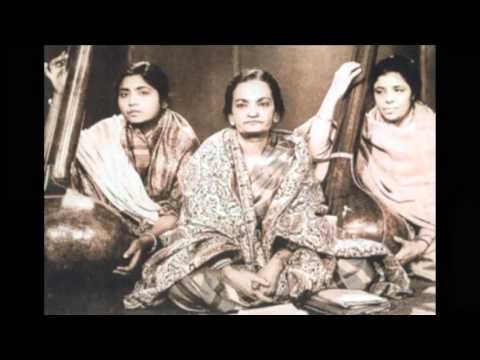
Her life mirrors the personal tragedies in Ghalib’s life (an 18th century poet) which he depicted in his ghazals. (which Begum Akhtar sang a lot) like:
Hazaro khaaishein aisi
Yeh Na Thi Hamari Kismet.
Koi umeed bhar nahi aati.
Phir Mujhe Deeda-E-Tar Yaad Aaya
Rahiye Ab Aisi Jagah Chalkar Jahan Koi Na Ho
Mushtari did not want her daughter to go through the same hardships in life, and wanted her to enjoy a proper education and a respectable married life. But Bibbi Akhtari was adamant – singing constantly and she disliked the confines of school. Her maternal uncle convinced Mushtari Bai to train her as a classical singer, seeing her talent in memorizing songs so quickly. Her training started under various gurus who tried to mold her naturally gifted voice. After early training under Ustad Imdad Khan of Patna, a famous sarangi player who chose to initiate her with raga Kamod, Bibbi found the raga difficult to cope with, as she was attracted to folk tunes. So she discontinued her lessons and they went to Ustad Ghulam Mohammad Khan of Gaya.
The family came back to Faizabad in 1923. She trained for four years under Ustad Atta Mohammad Khan of Patiala. The Ustad made her practice in the lower octave (Kharaj Bharan). Initially Bibbi was again on the verge of giving up her lessons, until one day she heard her Ustad elaborate the nostalgic Raga Gunkali and this experience transformed her completely, and she started to take her musical education earnestly. She practiced for hours on end, and her Ustad urged her to sing more soulfully. In 1927, the mother-daughter duo and the guru came to Calcutta, the music capital of India in those days. Despite her rigorous training in music; a tumultuous childhood cloaked the soul of the young singer in pathos. She flung open the window and stood transfixed and legend has it that from that day Bibbi literally opened her soul! She let her song soar through the abandoned corridors of memory. Her voice acquired a piercing ache that penetrated every lonely heart.
Her rendition of Mere hamnafas mere humnawaan
mere dost banke dagaa na de by Shakeel Badayuni was on many lips.
Aap kehte hain rone se na badlenge naseeb…
Rone wallon se kaho ke unka bhi rona ro lein
Jinko majbooriye haalaat ne rone na diya… brought her listeners to tears.
In the big city most of their possessions were sold and the few public performances she gave were not enough to make ends meet. She was coaxed to record her voice but the innocent spirit that she was, she said that If the recording machine sucked her life into the box along with her voice, her poor mother would be left alone, so she declined.
But her hard work and devotion bore fruit when her music was revealed to a wider audience by serendipity at a concert for the victims of the 1934 Nepal–Bihar earthquake. The famous poet Sarojini Naidu heard her sing there and appreciated her talent. After this she cut her first disc for the Megaphone Record Company, at that time. Akhtar’s first recording was a combination of ghazals and dadras for the HMV( His Master’s Voice) label and the ghazal : Woh Asire-Daam-e-Bala became popular.
Her mother Mushtari took her to a faith healer or Pirji in Bareilly and he opened her song book and put his hand: on Behzad Lakhanavi’s ghazal: Dīvāna banānā hai to dīvāna banā de
varna kahīñ taqdīr tamāsha na banā de
ai dekhne vaalo mujhe hañs hañs ke na dekho
tum ko bhī mohabbat kahīñ mujh sā na banā de
maiñ Dhūñdh rahā huuñ merī vo shama kahāñ hai
jo bazm kī har cheez ko parvāna banā de
The Pir asked her to begin her next performance with this ghazal, and so she did and in that fortuitous moment she cast a spell on the nation by this effervescent rendition! The ghazal was recorded – it became a mega success, running into platinum disc! This turning point in her life showered her with wealth, fame and luxuries. She was amongst the early band of female singers to give public concerts, and break away from singing in mehfils (private recitals), and in time she came to be known as Mallika-e-Ghazal (Queen of Ghazal). Begum Akhtar’s good looks and distinctive voice made her well suited for a film career in talkies. She acted in a few Hindi movies East India Film Company’s Ek Din Ka Badshah and Nal Damayanti. She acquired fame and a carefree lifestyle but she was still uneasy. Begum had a certain verve and charisma, a glamorous identity with a dash of bold red lipstick and finely embroidered georgette saris. But behind the dazzling smile and glimmering wizardry of her performance, the vulnerable lonely little girl was still ever apparent. I think this is what endeared her to her audience.
Yeh bahaar ka zamaana
Yeh hasin gulon ke saye…
Jise dekhni ho jannat
Mere saath saath aaye..
Later Begum Akhtar moved back to Lucknow and stayed there for three years where she was approached by the famous producer-director Mehboob Khan, to act in Roti (a socialist theme) with Sheikh Mukhtar and Sitara Devi which was released in 1942 where the music was composed by the maestro Anil Biswas. This film is available on Youtube in excellent condition, but her six songs were removed because of some contractual issues with the Megaphone Record Company. The audio portions were released later. She played a cameo role of a classical singer in Satyajit Ray’s Jalsaghar (1958), which turned out to be her last film appearance.
She was a chain smoker, she was constantly searching for something deeper, more meaningful, and more perfect, perhaps a happy childhood that was never hers. Begum Akhtar’s voice had a nasal twang, reminiscent of the film actress Meena Kumari, whose period movie Pakeezah (about the life of a courtesan) she watched six times because she had to take smoking breaks and was unable to watch the film to the end in one go. Once on a train journey she confiscated the accoutrements of the guard at a small railway station till he sourced cigarettes for her. She was a quite a handful but as a student of music, she was very humble, giving her gurus great respect.
In 1945, Akhtari Bai married a barrister, Ishtiaq Ahmed Abbasi, who was a connoisseur of Urdu poetry. She became Begum Akhtar. After marriage, she did not sing in concerts for five years. She was devoted to her role as a loving wife and took her domestic duties with as much sincerity as her singing (she did not even hum a hymn) but when her mother died, she fell very ill. A return to music was prescribed to heal her broken heart, and in 1949 she returned to the recording studios weeping tears of joy