When young people called the Santa Clara County Youth Crisis Line, Monta Vista High School senior Manan Dua, who works at the Crisis Line as a volunteer, noticed a pattern. Many weren’t asking whether help existed. They were asking where to find it and how they could actually get there.
These questions stayed with Dua. If resources were available but young people couldn’t navigate the system to reach them, he wondered, how useful were those resources? His answer was FCHome, an app that connects homeless and at-risk youth with shelters, food, healthcare, essential supplies, and free transportation.
Youth homelessness is often framed as a problem of limited resources. However, for many young people, the barrier can be more basic: knowing where to turn, understanding what help they qualify for, and figuring out how to access it.
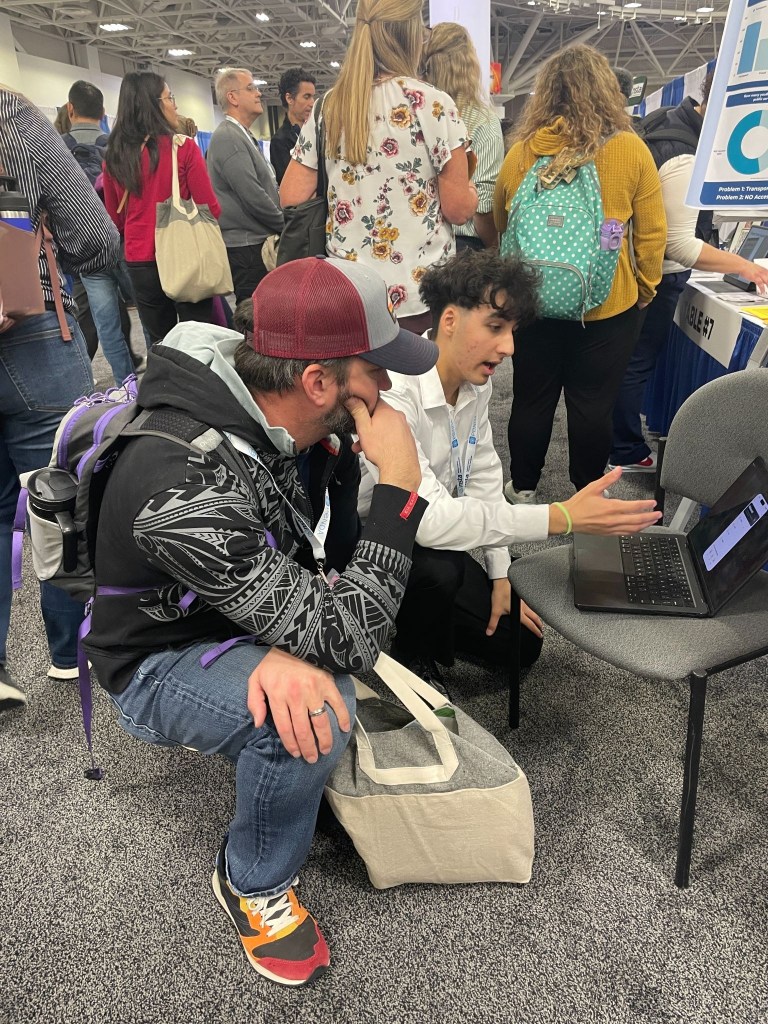
Since its creation, FCHome has grown beyond an app into a broader community effort. The project won first place in California’s 18th Congressional District in the Congressional App Challenge and has raised more than $7,000 for community outreach efforts, including food distribution and transit passes.
In this interview, Dua discusses the experience that inspired FCHome, the challenges of building the initiative, and his hopes for making resources more accessible to young people who need them most.
The excerpt below has been edited for brevity and clarity.
Tell me a bit about yourself.
My name is Manan Dua, and I’m a senior at Monta Vista High School in Cupertino. I’ve lived here my entire life, and both this city and the Bay Area have given me a lot over the years, from a strong community to real support when I’ve needed it. What I want to do now is return some of that by spending my time on the problems that affect people here.
What first inspired you to create FCHome, and was there a particular experience that motivated you to address homelessness?
For the past two years, I have volunteered on the Santa Clara County Youth Crisis Line, where I have spoken with many young adults facing homelessness, mental health crises, or both. One conversation has stayed with me. A caller named Marcus had recently aged out of the foster care system and had no one to turn to. He asked me two questions: whether the Bill Wilson Center would accept him, and if so, how he would get there. I frankly had no answer to either one. I redirected him to a more urgent hotline, and he found no help there.
When I later went back through the questions young callers were asking, roughly 43 percent were about where to find resources and 39 percent were about how to reach them. A centralized platform that showed eligibility requirements and provided a free bus pass to the shelter itself seemed like the most direct way to close that gap, and that became FCHome.
Why did you decide to use technology as a way to tackle this issue?
The decision followed from what I was seeing on the crisis line. The young people calling in already had phones, even if modest ones, through programs such as Lifeline. Printed resource guides, on the other hand, get lost easily, go out of date, and take far too long to distribute. A phone-based platform reaches people right away, and it lets us keep shelter listings and eligibility requirements in one place and up to date.
Transportation led to the same conclusion. Handing out physical bus passes to hundreds of young people across the region was never going to be practical, but sending them digitally, through a code on a phone they already carried, was something we could actually do.
How does the app work from a user’s perspective, and what makes it different from existing resource platforms?
We developed the platform with guidance from child psychologists, homelessness experts, and professional app developers, because we wanted the experience to feel manageable for someone who is already in the middle of a crisis.
From the user’s side, the process is simple. After creating an account, the user selects an age category, either Youth (ages 12–17) or transitional-age youth (TAY, ages 18–24), and arrives at a homepage organized into four resource areas: shelters, food, health, and supplies. The listings within each area adjust to the age category selected, since some shelters serve only one group. The homepage also includes a brief daily check-in, where users can indicate how they are feeling, and a private journal they can return to.


When a user finds a resource that suits them, they can select it on the map and choose among directions, a phone number, or a free bus pass. To access the pass, the user enters a unique code, and a staff member reviews each request to prevent misuse. We currently work with seven transit agencies so that a user’s location does not limit their access.

As for what distinguishes FCHome, it is the only platform of its kind built for this age group, and the only one that provides free transportation. To date, we have served 750 users across three states, distributed approximately 1,700 bus passes, and partnered with about ten shelters and service organizations. Most existing platforms are designed for older adults, and they list services without indicating who qualifies or how to reach them. In my experience, a resource a young person cannot reach or qualify for is not much of a resource at all.
Have there been any moments or stories from users or community outreach that have especially stayed with you?
Marcus’s story did not end with that first call. He called back some time later to tell me the other hotline had not been able to help him. At that point I went to the shelter myself to confirm they would accept him, and they would. The remaining obstacle was transportation. There was none available, and Marcus walked two hours to reach the shelter. That was the day I began building FCHome.
When the app was finally ready, Marcus became its first user. I remember the relief in his voice, and that moment has meant more to me than any award or recognition the project has received since.
Could you tell me more about your outreach efforts at Ohlone Court Apartments and the impact they’ve had?
Once the app was established, I wanted its benefit to extend beyond the young people reaching us through the crisis line, and we decided the most effective way to do that was in person, through food distribution. That search led us to CityTeam San Jose, an organization that distributes food at Ohlone Court Apartments, a low-income housing community, and we saw an opportunity to reach the youth living there.
Working alongside CityTeam, we have run food distributions in ten-week cycles, three of them at Ohlone Court and surrounding low-income housing communities, and we have distributed thousands of pounds of food across those cycles. The outreach also brought 27 new users onto the app, each of whom now has a transit code on hand should they ever need it. That combination is what made the effort worth continuing: the food meets an immediate need, and the app is there for a moment of crisis we hope never comes.
FCHome volunteers distribute food at Ohlone Court Apartments in San Jose on Saturday, Jan. 24, 2026. Pictured from left to right are William Liu, Aditya Dendukuri and Manan Dua after completing food distribution to residents in one section of the apartment complex. The photo was taken by a CityTeam San Jose leader. Courtesy of Manan Dua.
Your research introduces the idea of anticipatory housing action. How would you explain this concept to readers who may not be familiar with housing policy?
The model tracks a set of real-time indicators, the three principal ones being unemployment claims, eviction filings, and utility shutoffs. When those indicators cross a defined threshold, assistance is initiated automatically. It does not depend on prior enrollment; it is extended to everyone the indicators identify, with the option to decline.
The assistance itself includes short-term rental and utility support to keep the person housed, legal aid for those facing eviction, and a case manager who can arrange longer-term help. The aim is that by the time someone would have lost their housing under the traditional model, their situation has already been stabilized, and the time they spend in crisis comes down to almost zero.
What has been the biggest challenge you’ve faced while building FCHome, and how did you overcome it?
The biggest challenge was technical. I had little programming experience when I began, so I taught myself the necessary languages informally, as the work required them. Certain parts of the app, particularly the map system and the verification process behind the bus passes, called for skills well beyond what I had.
Eventually I realized that asking for help would get the app to these kids far faster than struggling through it alone. I went looking for developers in my community who had built apps before and who cared about this kind of work. To my surprise, about five people volunteered their time, and with their help we released the app a month ahead of schedule.
Looking ahead, what are your long-term goals for FCHome, particularly as you explore expanding your work to India?
FCHome currently operates in three states: California, Missouri, and Georgia. We intend to expand to all fifty, beginning with Oregon, Washington, and New York, which have among the highest rates of youth homelessness in the country. On the policy side, our relations team has begun attending city council meetings across the Bay Area to present the anticipatory housing action model, gather feedback, and assess how it might be implemented locally. We plan to carry that advocacy into other states as well, starting with Missouri and Georgia, where we already have partners.
Beyond the United States, we recently concluded an awareness campaign in India to raise funds for an Indian division of FCHome. We are taking a different approach there, focusing entirely on direct, in-person support for homeless youth.
What do you hope readers take away from your story?
What I most hope readers take away is that the obstacles facing young people are often smaller than they look. A lot of the time it comes down to something as ordinary as a bus fare or an eligibility rule that no one explained, and that alone can decide whether someone stays in crisis or finds help. I also hope the article encourages people to contribute however they can. Homelessness may seem out of place in the Bay Area, but in most cases it’s simply going unnoticed.