Shakti‘s uphill battle
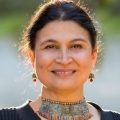
In the Hindu tradition, Shakti means power expressed as the divine feminine energy. This idea of Shakti – the all-powerful feminine, the source of life itself – is prevalent in many South Asian cultures and mythologies. But then, there’s the earthly reality of how women are perceived, treated and controlled. In her debut fiction film Shakti, Academy Award-winning filmmaker Nani Sahra Walker explores the latter by weaving an intimate narrative of a young mother as she tries to protect and fight for her daughter.

Set in Kathmandu, Nepal, Walker’s birthplace, the story follows an exuberant eleven-year-old Lila (Polina Oli) when she gets into trouble for stealing guavas from an orchard and defiantly refusing to apologise. As a child of mixed racial heritage – her father is American, and mother, Durga (Laxmi Bardewa), is a Nepali Dalit – she is already an outcast in her society and powerless at so many levels. But she exists in a bubble of innocence, oblivious to how the world sees her.
Her single mother, who works as a medical assistant in the local hospital, wants her to get her act together and behave. But her teacher, Ms. Joshi (Shrishti Shreshtha) is protective of the spark in Lila and suggests art lessons to channel the girl’s energy. Lila, who loves to draw, is excited by the suggestion, so her mother scrapes together enough money to send her for art lessons taught by the young son of the local art gallerist.
Thus begins the downward spiral of Lila’s personality. From an outgoing, carefree tomboy, she turns quiet, sombre and detached even from her art. Worried for her well-being, her mother and aunt try everything, fight every battle, only to beat their heads against the brick wall of institutionalized patriarchy. The story wants to make a point about the absurdity of the 35-day statute of limitations in reporting acts of sexual violence in Nepali law until 2015, and it does so with empathy and delicacy, honoring the dignity of the survivors.

Speaking with India Currents, Nani Sahra Walker discusses her process of making her debut fiction film, what inspires her, and the challenges and ways forward for independent filmmakers.
The interview has been edited for brevity and clarity.
Alka Raghuram (India Currents): How did you become a filmmaker? What kind of stories interest you?
Nani Sahra Walker: I studied philosophy and religion at Boston University. I was drawn to that particular school because the school of theology was where Martin Luther King Jr had spent a lot of time during his studies. It really interested me as a place to honor someone from the past whom I really looked up to. In high school, I made films blending photography and poetry. And then in college, I had a lot of friends in the film school, so I would spend most of my time there, even though I was studying religion and philosophy.

After I graduated, I moved to New York City and ended up working in film for the next five years, everything from production to post-production and learning as many skills I could by working on short films to broadcast network television shows. One of the first films I worked on was Michael Moore’s Fahrenheit 911. It was one of those breakthrough documentaries that won the Palme d’Or (at Cannes) and had a theatrical release, which was unheard of at the time for documentaries.
I later moved to the Bay Area and established a company between LA and San Francisco.
I was born and raised in Nepal before immigrating to the Bay Area. At the time, I had read about the Supreme Court verdict in Nepal allowing for a third gender. It was quite progressive, especially in South Asia, where in some countries LGBTQ individuals were either incarcerated or facing violence. I made a feature-length documentary, The Other Nature, in 2012 that premiered at BFI Flare in London and went on to screen at Frameline, Outfest and a dozen other film festivals worldwide.
I went back to grad school later in my career. I had moved back to the Bay Area and was looking for a creative community. I realized that a film community in the Bay Area is either affiliated with Stanford or Berkeley and their respective film schools. I felt more aligned with the activism and social justice at Berkeley and ended up going to the Berkeley program.
Shortly after, I moved to LA and started working at the Los Angeles Times where I launched the short documentary platform. It was an opportunity for me to work on the curatorial side, and I had never done that. It was very exciting to support fellow filmmakers and to champion other people’s projects.
AR: Film is such a multidisciplinary medium with so many different types of artists coming together to tell the story. That aspect is rarely highlighted in conversations about vision. Shakti is such a beautifully shot film; the production design is amazing, as is the sound. I wanted to ask you about your collaborators – the people who contributed to your vision by adding their vision to the story.
NSW: I completely agree. Filmmaking is such a team sport. It really is about finding those collaborators who are able to work towards that one vision. And I was lucky enough to work with some incredible people. My DP (director of photography), Keiko Nakahara, has some big-budget Bollywood films like Mary Kom and Tanhaji under her belt. When I sent her the script, she was like, “I have to work on this film, and we have to find a way to do this.” And the amazing thing was she was seven and a half months pregnant while filming!
My production designer and producer, industry veteran Candi Guterres, and I had collaborated before in the art department. Candi had hired me on three films when I was working in Los Angeles. Candi is a veteran, a production designer who has worked on sets like Anna Karenina in Russia. I reached out to Candi and told her I was making my first feature in Nepal and Candi said, “I want to go. I’m going to come with you. There’s no question about it.”
My composer from the Bay Area, William Ryan Fritch, whom I had worked with on a short film earlier, really understood the vision and what I was trying to do. So all the way from Nepal and the U.S., we did a lot of incredible collaborations between many cities and places and people.
AR: That leads me to actors, who embody the story. I was particularly struck by the main character, the young actress Polina Oli. What was your process of working with her? Especially because hers is a key role and it’s so delicate to communicate abuse to a child actor.
NSW: It was really important for us not to expose her to any trauma. That was a conversation we had early on with her and with her family. While she’s a protagonist, the story is also what we want to protect children from. But both her mom and dad were very supportive of the film and what we’re trying to do with it. We also wanted to be aware of the impact. There was a lot of conversation around that.
We started auditioning during COVID and did them over the course of a year. I traveled twice to Nepal. On the first trip, we didn’t find the young girl despite a huge pool of young actors in Nepal. We went to theater companies, schools, but as you mentioned, it’s a really tough topic. I think a lot of young girls were not even aware enough to be able to embody that. And then some were afraid. It was like their parents had brought them because they wanted their child to be in the film. But the girls themselves were scared. That’s not something we wanted to do to any person – instill fear and have an unpleasant time with it.

When we first met Polina, first of all, both her parents are just incredible people. They’re both physicians and also activists in Nepal committed to bringing awareness around women’s and family rights. They’re a mixed-race family — Polina’s mom is Russian and her dad is Nepali. Her father was present during the scene – one of the only – where there’s any contact at all. And it’s suggestive rather than explicit. We took a break after every take and made sure that she was feeling safe and comfortable.
Because child actors don’t have the tools that seasoned actors have, we did some workshops with her; rehearsals to feel comfortable with the other actors, to understand not just the difficult scenes, but also the fun scenes with her friends. I don’t like to rehearse much because I want more spontaneity. But with her, I felt it was important to spend enough time to create this environment of comfort and openness; she was able to move in and out of different emotions and emotional states. I think she is a natural and such a good actor. The day that we wrapped, she got on a chair and announced to the cast and crew that this had been her dream, to be a child actor!
AR: Filmmaking is such a resources-intensive endevor. How did you put together your first narrative film?
NSW: The business side of film is so important. As filmmakers, we want to just be steeped in creativity. It’s been a learning process for me, but one that has been really exciting because it gives us the ability to, one, retain creative control and, two, be able to make films without having to seek somebody else’s permission. Back when I hadn’t even written a word of the script, I started talking to friends and colleagues in different aspects of the business.
One of my early conversations was with a friend and colleague, Jordan Mattos, who has a small boutique distribution company. He went to NYU film school, and rather than making his own, he helps people find distribution for their films. He told me something that is really important advice — think about distribution as the first step in making a film. Also, think hard about your priorities. In the beginning it’s like – “I want everything. I want the prestige festivals, I want to make money. I want everybody to see it.”
But Mattos told me, “Okay, if you had to choose, how would it line up?” It was pretty clear to me that I wanted as many people to see it as possible because the ultimate goal of this film is to make an impact. That decision was also informed by my documentary practice, because so much of documentary is centered around an impact campaign.
Once I set that as my main priority, I realized that while festivals are great, only a handful of people see them. Thousands at best. And then it gets lost. A lot of films are nowhere to be found again. And I didn’t want that to be the case for my film. It was important for the film to be accessible and out in the world. It’s not that I had distribution early and upfront; for a first-time feature filmmaker, that’s usually not the case. So I took the risk and started raising money.
In the U.S. there isn’t a lot of public funding for films. So we have to get really creative. I had gone to a couple of markets and labs, and through those relationships got a grant with Arri’s International Support Program. The camera package was paid for, and that’s really important because if we had taken it out of our own pocket, we may have had to compromise the quality of the visuals.
I had multiple versions of the budget. If you’re making a film, there’s always the dream budget and then there’s the absolute-absolute shoestring budget that you can make this film with. I approached people in the community, knocked on all doors. A professor I’ve been working with in Oregon, Dr. Lalit Khandare, introduced me to an entrepreneur, Snehal Fuzele. Snehal and his wife Vrushali Satarkar read the script, the deck and they were fascinated. They wanted to make an impact in the community, and so they came on board. That was really one of the biggest moments of validation and support. And then, of course, I funded this film with my personal money.
AR: This usually is the first question, but we’ll end with it. How did the story come about? Why did you want to tell this story? What kinds of stories attract you?

NSW: The trigger for the story was the 35-day statute of limitations in Nepal to file cases of sexual violence. When I read that I thought it was insane. The place that I call home, the place that I think of as somewhat progressive in South Asia, was this restrictive for people seeking justice around sexual violence. When I started digging deeper and how many people are actually experiencing violence, it’s more than one out of two women.
It’s partially a personal story, but it’s also a collective story. And that was something that I really wanted to talk about because it’s taboo. The moment that we start to have a dialogue about it and we call it out and name it and actually acknowledge that this is happening in our world, in our societies, in our families, then there’s space to heal, to find justice.
AR: I think this subject lends itself to fiction because documentaries can be harder – there is so much shame that people carry.
NSW: Exactly. And I wanted to protect the privacy of survivors. I just felt like this is a place where fiction is the perfect transition for me. I had more time to write and think about it and to naturally move into fiction.
AR: And lastly, what’s next?
NSW: I’m not really married to one genre. I’m developing a dramedy, so it’s a bit lighter. It’s still a family drama – I’m very drawn to family stories. But the next film is set in California. I’m looking for investors who want to come on board.
As an independent filmmaker, I definitely want to make sure that our films are not just made, but also seen and that we’re able to monetize the various aspects of the IP (intellectual property) and not just hand it over to a big company or a huge distributor. I think this is the age of taking things in our own hands and being creative with distribution and with the process of making films. Everybody wants so much of your pie for so little, and then you’re so desperate that you just give it away so that you can get your story out there.
Shakti is available to watch for rent on Amazon Prime Video. It is streaming free in the U.S. and Canada on Tubi and worldwide on Fawesome.