


Estimated reading time: 11 minutes
Faith & Harmony
It was in the fall of 2025 that Maryland Lieutenant Governor Aruna Miller first spotted the Buddhist monks on their “Walk for Peace” on social media. The monks, along with Aloka, their faithful canine companion from India, had walked more than 2,000 miles for over 100 days from Fort Worth, Texas, on their way to their final destination right next door in Washington, D.C.
So Miller reached out to the men of peace with a request to make a pit stop at the Maryland State House. On February 12, nearly 12,000 Marylanders showed up to greet the monks, the largest peaceful gathering the Maryland Capitol Police had ever seen.
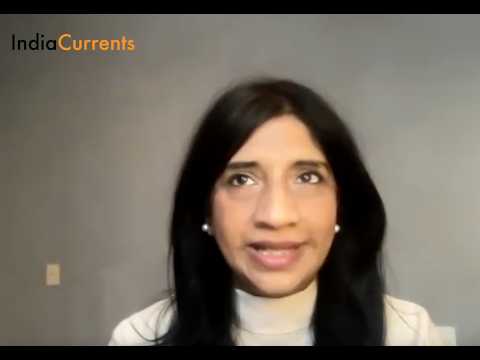
“Many of us in the world right now, we need that comfort of peace, light, hope. I think that’s missing in the national and global dialogue,” said Miller in an interview with India Currents.

Raised in an interfaith home and now a part of one, the principles of empathy and peace are central to Miller’s run for office. “From the moment I wake up to the moment I close my eyes, I want to be able to give the world the best of me,” she said.
In 2022, Aruna Miller made history as the first South Asian woman to be elected Lieutenant Governor. She is also the first immigrant and the first woman of color to hold statewide office in Maryland. This year, she will seek a second term as LG along with Governor Wes Moore. Maryland’s primary election is scheduled for June 23.
The monks’ mission of peace aligns closely with Miller’s mandate as chair of Maryland’s first Council on Interfaith Outreach, which she founded in 2023. “[Maryland is an] intersection of so many different ethnic backgrounds, cultures, religions. We know the impact faith communities have on individuals, right? They’re sometimes the first place people turn to during times of distress, during times of need.”

For the council, which now has over a dozen members, Miller tapped several local faith-based organizations, including the Islamic Society of Baltimore, the Celebration Church Columbia, the Baltimore Hebrew Congregation, and the Shri Mangal Mandir Temple. “I thought …why don’t we bring all those faith leaders together and work together on policies and shared values that all of us have, that we can really work collectively?”
Miller herself was raised in what she calls ‘an interfaith household’. Her father was a devout Hindu, and her mother, who was born Hindu, grew up in the Catholic tradition. She told her family she had wanted to become a nun, laughs Miller.

She remembers a childhood in which her father prayed to Hindu Gods, while her mother sent Miller and her siblings to Sunday school. “Both of them worked beautifully together,” she said. “There was never any ‘my faith is better than yours.’ As long as you have faith and believe in the greater goodness in this world, that’s what makes all of us better.”
Those values have continued to inform her syncretic life with her husband David, their three daughters, and her mother, who lives with them. Although not a temple-going Hindu (the LG famously took her oath of office on a Bhagavad Gita), Miller said she practices its values every day. “Any faith that teaches you to be a good human being, to be caring, to be compassionate and empathetic, I’m open to all of it.”
From India to the “confetti” of New York

Aruna Miller was seven when she arrived in New York from Hyderabad in 1972. She knew no English and barely knew her own parents or her brother and sister because her maternal grandmother raised her until she could finally come to the United States. Her father, who left India to pursue a PhD in mechanical engineering, could only afford to bring his family to America one at a time.
It was a bittersweet moment for a terrified girl, traumatised by her separation from her grandmother, but excited to be reunited with her family.
“I remember getting off the plane in New York and thinking, wow, look at all these people waiting at the airport for my dad and me! I thought they were all welcoming my dad and me to this new country…And I got so excited because I thought they were throwing confetti to further welcome us! But it wasn’t confetti, it was snow! I had never seen snow in my life. I remember how warm it made me feel – like I love this country already!” Miller recalls.
Inspired by her father, Miller pursued a civil engineering degree and worked as a transportation engineer for Montgomery County’s Department of Transportation for 25 years.
And then public life came calling.
An “accidental” transition
Miller often describes herself as an “accidental politician” who didn’t care much about running for public office, until she realised, as a newly minted citizen who had voted for the first time in the 2000 American presidential election, that democracies run on more than just a vote. She realized that “a lot happens before a candidate is actually elected. There’s a lot of boots on the ground.”
She began volunteering for the Democratic Party and five years later was asked to run for office herself. The hesitant immigrant engineer was then elected first to the state’s House of Delegates (2010–2019), representing District 15, and then as Gov. Wes Moore’s running mate. “I had all these doubts that the community would never vote for a person who looked like me… [but] when you’re running on ideas that you believe will benefit the community and they feel like they can trust you, they’ll vote for you,” said Miller.
Public engagement is no longer a choice
While acknowledging that running for office or engaging in politics can be daunting and a steep learning curve for immigrants, Miller said not engaging was not a choice now.
“Politics in and of itself is very conflict-oriented, and a lot of times the last thing [immigrants] want to do is to be in a situation where there’s conflict. There’s a lot you have to read up on…a thousand pieces of policies come through our state offices every year…it’s a lot of homework you got to do,” she recognized.
“[But If] you have the ability to vote and you’re not voting, guess what? You’re giving the power to the individual who is voting. They’re voting for you now,” she warned.
When an immigrant or a member of a minority community runs for office, they have a “trickle-down effect”, said Miller, drawing out more community members to participate in public life.
“Candidates and elected officials reflect the diversity of their communities; racial, ethnic, and religious minorities feel less political alienation and have more trust in government,” she said.
Strength in diversity
Miller says that when she and Gov. Moore were elected, they created the most diverse cabinet ever in Maryland’s history, a distinction that reflects the diversity of their state. The 2020 Census ranks Maryland as the most diverse of the mid-Atlantic states; it is a majority-minority state with over half of its population identifying as non-White, 2.5 percent being of South Asian origin.
“Diversity is what Governor Moore and I see as our strength,” said Miller. “We had the most amount of Asian American cabinet secretaries in the continental United States.”
In 2012, the Maryland Governor’s office set up a Commission on South Asian American Affairs, which was reconstituted in 2025. But rising anti-immigrant sentiments and attacks against South Asians, especially online, can chill a community’s efforts to engage in public life. Several sources have reported a significant uptick in anti-Indian hate speech online. A recent report released by Stop AAPI Hate has revealed a significant surge in online hate against the Asian community, with South Asians being the largest targets since November 2024.
Miller says the anonymity of the internet gives online hate its impetus. “We’re just living in an age where people have access to the internet, and it’s easy for them to live in anonymity, and yet make terrible attacks on individuals,” Miller said.
She also points to an emerging pushback narrative that blames the successes of one community at the cost of another. “You see a lot of that [hate speech] because they want to point fingers at a certain community and say, you’re the reason why I don’t have a job, you’re the reason why I’m living in poverty,” she said.
To counter the hate, the LG said the state gave grants to places of worship so they can beef up their security and educate their communities. “That’s why it’s so important that we speak as one voice… we protect one another, our brothers and sisters of different ethnic backgrounds, different religions.”
H-1B visa program needs reform
In December last year, Maryland joined a coalition of 19 states that sued the Trump administration for imposing a $100,000 fee on new H-1B visa petitions. The state depends heavily on H-1B hires to staff its schools, healthcare system, and universities.
Maryland boasts one of the highest concentrations of STEM professionals in the country. The state consistently ranks near the top in the country for higher education; 43.4 per cent of residents over age 25 hold a Bachelor’s degree or higher. It is home to some of America’s most prestigious universities (University of Maryland, Johns Hopkins University) and over 100 federal agencies, labs, and military installations, including the National Institutes of Health (NIH), the Food and Drug Administration (FDA), and the National Security Agency (NSA). making it a beneficiary of STEM immigrants on the H-1B program, many from India.
Noting that one in five Marylanders is born outside the United States, Miller said the H-1B was a good program that needed urgent reform.
“Anytime you shut out individuals who want to come to this country and contribute …who want to share the best of who they are, to grow our economy, to come up with innovative ideas that make the world a better place, I think we’re the country that’s at a loss,” she said.
While immigrants have found success through the H1B system, Miller thinks the program needs rethinking. It must be made more efficient, added Miller, allowing for workers to change jobs, and cut down on decades-long wait times for Green Cards (permanent residency) and paths to citizenship. “I think the H-1B visa program needs to be amped up, made better so more people can come to our country and add to our economy,” she said.
More than just feds, eds, and meds

With the H1B fee hike came a tight squeeze on federal research funding and federal job losses, deeply impacting Maryland’s economy. ”We have lost 25,000 federal jobs in the state of Maryland. This is the most of any state in the nation,” LG Miller said.
One of the state’s responses, Miller said, was to divert the highly educated but now displaced workforce to help resolve the state’s acute shortage of educators. “After COVID, we saw a steep decline in individuals becoming educators, so we saw this as a great opportunity to take displaced workers and give them a fast track toward becoming an educator, so we were able to fill these vacant positions and at the same time, give an opportunity for the displaced workers to find work as wholesome as teaching,” Miller said.
The state, however, has been moving to diversify the economy for some time by supporting small businesses and attracting large investments like the pharma giant AstraZeneca and The Sphere, the Las Vegas entertainment facility.
“We can’t just lean on the feds, eds, and meds, you know,” Miller said.