Why I Dance – A monthly column, in collaboration with IndianRaga, in which we uncover the variety of Indian Classical Dance forms and their lineage.
This first edition of the Why I Dance Column features Sattriya, an Indian Classical dance form originating in the state of Assam.
Originally developed by the great seer-polymath Shrimanta Shankardev, the art form is based on the Bhagvat and takes its roots in neo-Vaishnavism. As a means of social reform, Shankardev aimed to use Sattriya to meet the goal of cleansing the society of caste and creed hierarchy. Shankardev also used this artistic medium for the propagation of the philosophy called Eka-Sharan-Naam-Dharma (the religion of taking refuge in the name of the only One). Sattriya dances and dramas that are based on the works of Shankardev and his disciple Madhavdev are performed by groups of dancers and actors in a Prayer Hall called “Naamghar”.
To Prateesha Suresh, Sattriya dance has meant everything. Trained in both Sattriya and Bharatanatyam, she has been instrumental in the recognition of Sattriya as a classical dance of India, which it was declared as by the Sangeet Natak Akademi in 2000. She notes that: “I learnt Bharatanatyam and took up Sattriya (which I learnt as a child) as it belonged to my state and at that point, we were trying to establish its classical status. I performed a lot with lecture-demonstrations for that cause. Today, although Sattriya has gained its classical status, there is a lot of work yet to be done.”
She continues to inspire Sattriya practitioners around the world through her choreographies and lecture-demonstrations, where she breaks down the artform for those unfamiliar. About Sattriya, Prateesha says, “It has many layers to it like a “Shastra” and I am trying to unfold those layers every day of my life!”
Sattriya is a lived tradition, having been practised continuously since its inception by men in institutes called Sattras. In the 1970s, Sattriya emerged from the Sattras, against the wishes of many. Dances in the Sattriya repertoire are based on the Sutradhari Dance, among others created by Shankardev, as a part of the drama called Ankiya Nat.
Dances in the Sattriya repertoire are divided into three sections; Ramdani, Geetor Naach, and Mela Naach, which refer to the ‘the beginning’, ‘the middle’, which is the dance accompanied to a song, and ‘the conclusion’.

The percussion used in Sattriya is called a Khol, and does not follow the same jati system used by many other classical dance forms. Because of this, the changes in tempo are done gradually and are not calculated (which is how the jati system works).
The basic posture of the art form is the half-sitting “mandala” posture called Ora. In Sattriya, the body moves in undulation and the arms are always bent at the elbows and follow a circular path. The torso is held in samabhanga, dvibhanga and tribhanga positions mostly bending forward or side to side. Acrobatic movements like bending back and touching the ground, and either standing or sitting on the knees are also seen in the art form. The fingers of the palm use all the “hasta karana-s” as mentioned in the Natyashastra.
The costuming in the Purush (male) style is Krishna’s attire. It consists of a yellow coloured dhoti, dark blue coloured upper-garment in the angarakha style called “chapkon”, richly embroidered waist girdle with hanging pearls called “kanchi” either in dark blue or black colour and a black or dark blue embroidered crown over the head.
The costume of the Prakriti (female) style is a plain white skirt, two panels over each shoulder with patterns which join in a “V” at the back, like the Sutradhari. Dark blue or black coloured blouse with rich embroidery. A long piece of cloth tied at the waist, ends hanging in the front called “tongali”. A richly embroidered waistband with two panels hanging from either side called “aachol”.
Sutradhari costume has both the elements of ‘Purush’ and ‘Prakriti’, where the dancer wears a white skirt, two panels over the shoulders joined at the back in a ‘v’, a long piece of cloth tied at the waist, the ends hanging in the front called ‘tongali’ and a white head adornment which is in the shape of a “kosha”. Traditional Assamese jewellery like “unti” (earings), “muthi kharu”, “gaam kharu” (bracelets), “mota moni”, “dugdugi”, “gejera/junbiri” for the neck are worn. Light dancing bells called “junuka” are worn on the feet.
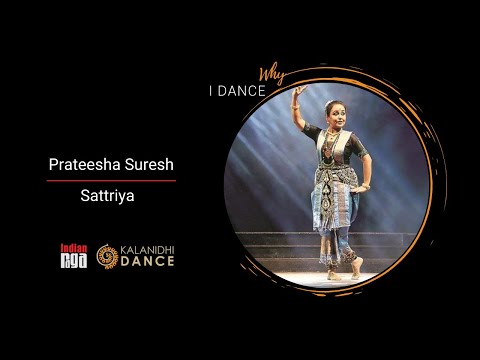
The Why I Dance Campaign is a collaboration between Maryland based Kuchipudi company Kalanidhi Dance, and IndianRaga. IndianRaga provides a platform for aspiring artists to explore their talent, with opportunities to focus on presentation and performance, high-quality audio and video production for digital channels, and learn how to collaborate with fellow artists.
Tune in next month to learn more about the Indian Classical Artform of Odissi!
Tarini Kumar is an IndianRaga Bharatanatyam Fellow and Why I Dance team member. She is a disciple of Smt. Divyaa Unni, and currently studies at the University of Texas at Austin.